The true maturity of a venture market is measured not only by total capital deployed, but also by how effectively investors collaborate with one another. Insights from the first two quarters of 2026 reveal that Uzbekistan’s venture ecosystem has entered a pivotal new phase: the rapid emergence of a co-investment culture.
Today, local venture funds and angel investors are choosing coalition and capital syndication over direct competition.
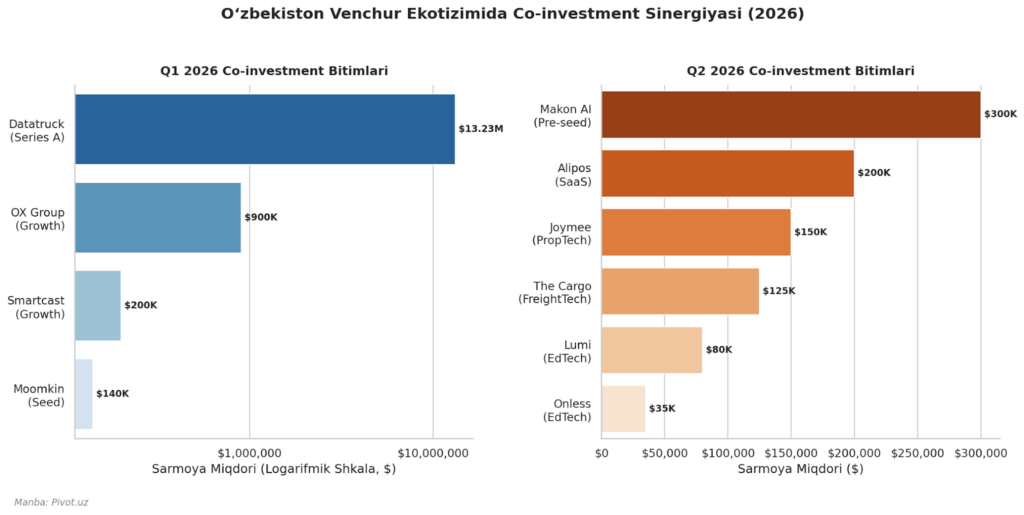
- Q1 2026: growth-stage collaboration and megadeals
In the first quarter of 2026, co-investment primarily served to fund late-stage ventures (Growth Stage and Series A). During this period, the main focus was pooling large checks and distributing high-stage risk:
- Datatruck (Series A — $13,235,000): In this flagship deal, local and international institutional players—Avenue Growth, AloqaVentures, and IT Park Ventures—invested jointly.
- OX Group (Growth Stage — $900,000): This SaaS startup was co-funded by IT Park Ventures and United Ventures.
- Smartcast (Growth Stage — $200,000): Another SaaS/AdTech deal backed jointly by IT Park Ventures and United Ventures.
- Moomkin (Seed — $140,000): The sole early-stage syndicated transaction in Q1, backed by AloqaVentures, Yoshlar Ventures, and an angel investor.
In short: During Q1, none of the 7 early-stage (Pre-Seed) deals—totaling $355,000—featured co-investment. Startups at this phase had to rely on a single fund or private backer. Collaboration remained exclusive to larger, growth-phase rounds.
- Q2 2026: Synergies Shift to the Early Stages
The dynamic shifted dramatically in the second quarter. The co-investment model cascaded down from late-stage growth rounds directly into the earliest layers of the ecosystem—Pre-Seed and Seed:
- Makon AI (EdTech — $300,000): This Pre-Seed startup secured capital simultaneously from three venture funds: Yoshlar Ventures ($125,000), AloqaVentures ($100,000), and IT Park Ventures ($75,000).
- Joymee (PropTech — $150,000): This real estate startup raised $150,000 in aggregate across stages from AloqaVentures ($20,000), IT Park Ventures ($50,000), and Nexus Club ($80,000).
- Alipos (SaaS — $200,000): A retail and service automation platform raised $200,000, co-funded equally by Imkon Ventures ($110,000) and angel network Nexus Club ($90,000). This demonstrates how private angel investors seamlessly co-invest alongside institutional VC firms once thorough due diligence is completed.
- Onless (EdTech — $35,000): Co-funded by AloqaVentures ($10,000) and Yoshlar Ventures ($25,000).
- Lumi (EdTech — $80,000): Supported in equal parts by Yoshlar Ventures ($40,000) and an angel investor ($40,000).
- The Cargo (FreightTech — $125,000): The logistics enterprise raised capital from Yoshlar Ventures ($80,000) alongside two separate angel investors ($30,000 and $15,000).
For developing ecosystems with developing capital reserves like Uzbekistan, syndicated investing is the optimal growth strategy:
- Risk Mitigation: Local funds no longer need to over-concentrate exposure on single early-stage startups. Spreading risk among two or three co-investors ensures portfolio stability.
- Larger, Institutional-Grade Checks: Startups are escaping fragmented $10,000–$20,000 solo checks, securing structured rounds ranging from $150,000 to $400,000.
- Smart Money Amplification: Startups gain access to broader networks, technical expertise, and operational support across multiple venture firms rather than relying on a single backer.
If you are a startup founder, move away from single-investor pitching strategies. Structure your pitch deck for syndicated rounds (multi-investor participation). VCs are actively communicating—if you successfully clear due diligence with one fund, they can easily syndicate the rest of your round with partner funds.