AI is taking on a growing share of everyday and professional tasks. Tools such as ChatGPT can now write, search for information, analyze data and help make decisions. The more these systems are integrated into daily routines, the more relevant another issue becomes: how dependent can people become on them?
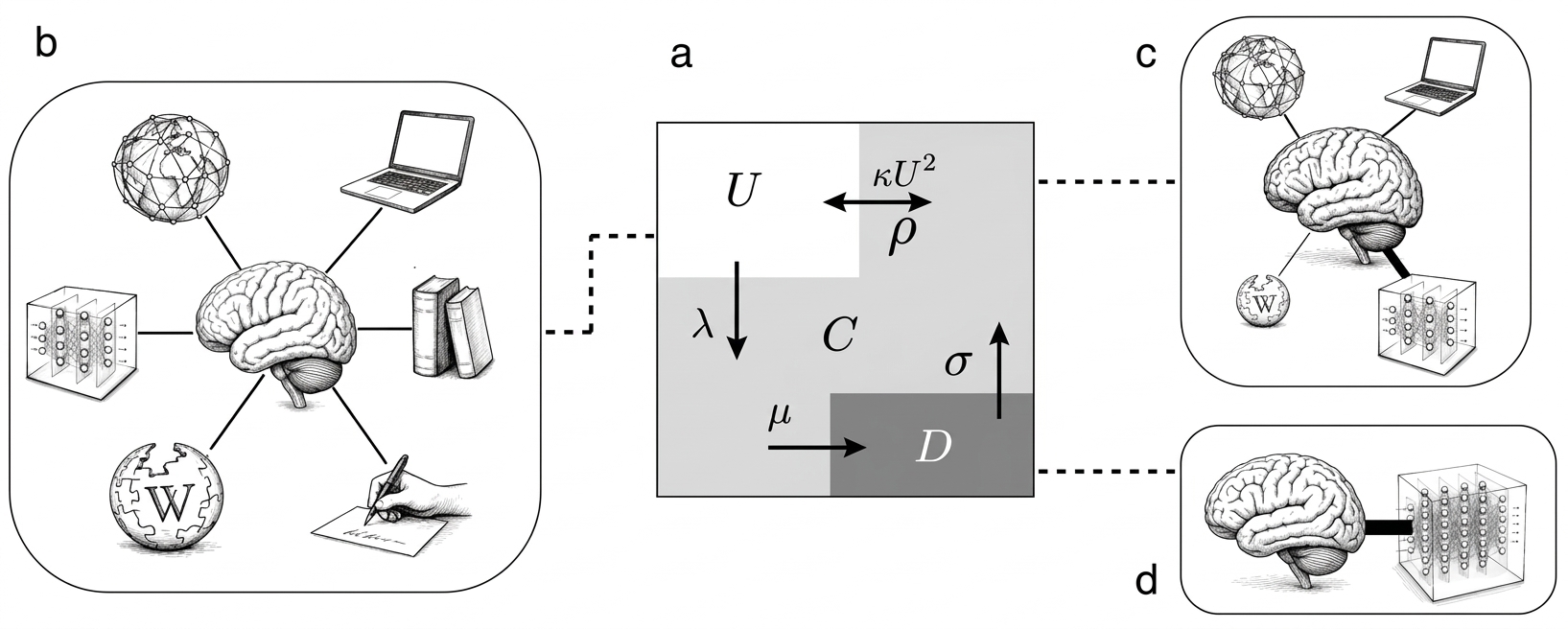
A new paper published on arXiv on September 3 examines the spread of large language models, including systems such as ChatGPT, using an epidemiological model. The authors describe this process through the analogy of a “cognitive virus.”
The term does not mean that AI is a biological virus. Instead, the researchers use epidemiological models to examine how patterns of AI use can spread from one person to another and change over time.
The model divides people into three groups. The first group consists of people who rarely use AI and continue to perform tasks such as learning, writing, remembering information and reasoning independently.
The second group uses AI regularly but remains capable of working without it. For example, they may use ChatGPT to generate ideas or structure a text, while checking facts, making their own conclusions and completing tasks independently when necessary.
The third group becomes increasingly dependent on AI. Tasks such as searching, analyzing, writing or making decisions are gradually delegated to the model. This third stage is where the researchers see the greater potential risk.
The problem is not using AI
The model suggests that AI adoption may not increase at a constant rate. At first, the number of users can grow gradually. But after reaching a certain tipping point, the process can become self-reinforcing. As AI becomes more widespread, using it becomes increasingly normal, which can encourage even more people to adopt it.
Consider a workplace where almost everyone uses AI to prepare reports. Choosing not to use it may eventually mean spending significantly more time on the same task. The same dynamic can appear at universities when most students use AI for writing, research or problem-solving. Technology can therefore shift from being an individual tool to becoming a social norm.
One of the more interesting concepts in the paper is hysteresis. In simple terms, once AI use has reached a certain level, reducing that use may not automatically return people to their previous level of independence.
A person who has become heavily dependent on AI could reduce their usage without immediately regaining the ability or habit of performing the same tasks independently.
According to the model, reversing the process may require a much stronger reduction in dependence, combined with deliberate practice of independent cognitive skills. This is why prevention can be easier than recovery.
The paper does not provide evidence that AI inevitably reduces human cognitive abilities. Some of the assumptions in the mathematical model are illustrative rather than measurements taken from real populations.
For example, the authors assign relative cognitive-competence values to different user groups in one of their simulations. These numbers are part of the model, not measured scores showing how intelligent real AI users are.
The authors also acknowledge that AI can work as a form of cognitive scaffolding and potentially preserve or improve some human capabilities. The issue is therefore not simply whether people use AI. It is whether they can still perform the same task without it.
The paper does not argue that people should stop using AI. Instead, the researchers introduce the idea of “cognitive immunization” — maintaining practices that prevent AI assistance from replacing independent thinking.
This could include: keeping some tasks that must be completed without AI; checking AI-generated information instead of accepting it automatically; regularly writing, calculating and solving problems independently; keeping final decisions with the human rather than delegating them entirely to AI; reducing the transition from ordinary AI use to persistent dependence.
The model also examines how changing the rate at which users move from ordinary AI use to persistent dependence can affect the overall outcome.
People have always used technology to outsource parts of memory and thinking. Books expanded our ability to store information. Calculators reduced the need for manual calculations. The internet changed how we search for information.
LLMs are different in one important respect. They do not simply store or retrieve information. They can write, summarize, generate ideas, compare options, produce code and reshape the way an argument is presented. That brings these systems much closer to everyday cognitive processes than many earlier technologies.
The researchers refer to this relationship as human-AI coupling and use their model to explore how that relationship could develop at the population level. The important question for the AI era may therefore not be whether AI will replace humans. It may be much simpler:
Which skills does AI help us strengthen — and which skills are we gradually allowing it to perform instead of us?
The biggest risk described by the model is not using AI. It is reaching for AI even when we no longer need it.