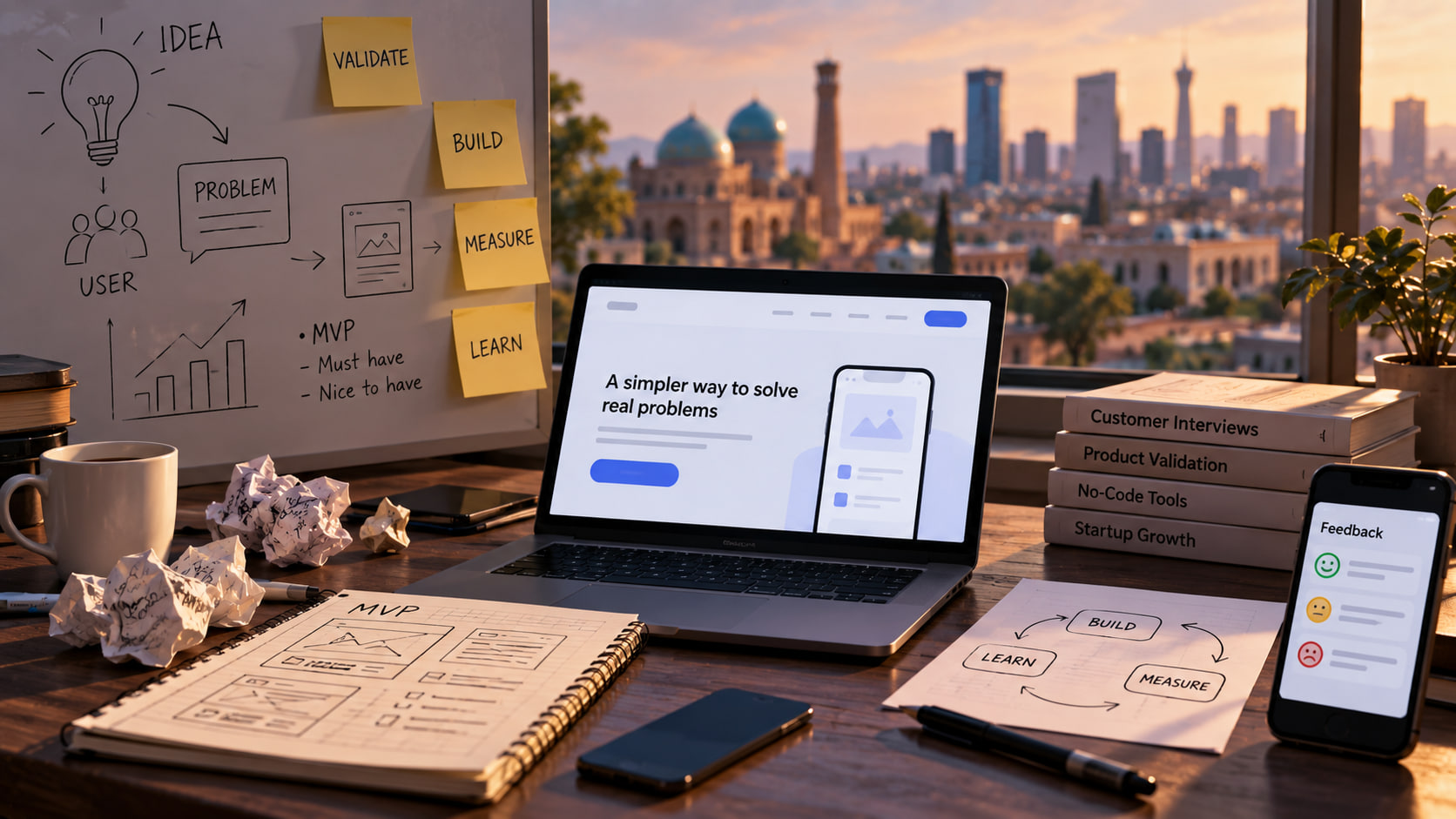
Many startup founders fall in love with their own ideas and spend months, or even years, investing significant time and capital into building what they believe is an ideal product. Unfortunately, once launched, they often discover that nobody actually needs it. To prevent this fatal mistake, the startup ecosystem relies heavily on the concept of the Minimum Viable Product (MVP).
To learn about the core differences between a startup and a traditional business, read our pillar article: What is a startup, and how does it differ from a traditional business?
1. What is an MVP?
An MVP (Minimum Viable Product) is the earliest functional version of a product that carries just enough minimal features to solve a core user problem.
The primary goal of an MVP is to launch a product into the real market as quickly and cost-effectively as possible, gather authentic user feedback, and validate key business hypotheses.
According to research by CB Insights, 42% of startups fail primarily because they build products with “No Market Need.” An MVP minimizes this specific risk to the lowest possible level.
2. Main types of MVP approaches
| MVP type | How it works | Notable example |
| Wizard of Oz | Operations are performed manually behind the scenes, yet appear fully automated to the end user. | Zappos (Took shoe photos in local stores and uploaded them online) |
| Concierge | The service is initially delivered manually and personally to each individual customer. | Foodontrack / Early-stage consulting |
| Piecemeal | Assembled by combining existing free or low-cost tools (Typeform, Zapier, Google Sheets). | Groupon (WordPress + PDF coupon generation) |
| Landing Page MVP | Features only a product overview page paired with a pre-order or waitlist call to action. | Buffer (Tracked user clicks on pricing option buttons) |
3. Step-by-step stages of building an MVP
- Define the problem clearly: Identify precisely which target audience you are serving and what specific pain point you are solving.
- Analyze competitors: Examine what solutions competitors offer and determine your core competitive advantage.
- Prioritize features: Separate product features into “Must-have” (Essential) and “Nice-to-have” (Optional), retaining strictly the “Must-have” elements.
- Develop the MVP: Build the initial version within 2 to 4 weeks utilizing No-Code tools or rapid frameworks.
- Measure and learn (Build-Measure-Learn): Analyze real user behavior and continuously iterate the product.
If your MVP testing yields underperforming results, it may be time to strategic pivot. Read our article: What is a pivot? When and how should a startup change its direction?
Frequently asked questions (FAQ)
Question: Should an MVP be poorly made or visually unattractive?
Answer: No. While an MVP must remain minimal, it must be well-crafted and functionally stable enough to reliably solve the user’s core problem.
An MVP is the most efficient method for conserving capital and time. Before seeking major investment rounds, validate your core hypothesis using the simplest possible MVP format.