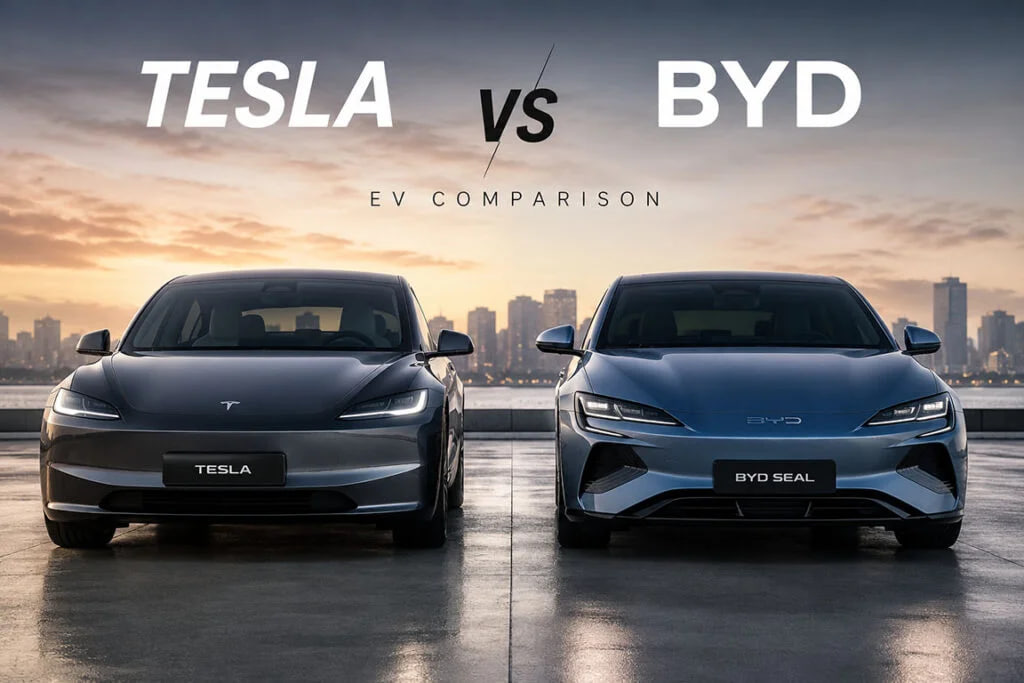
Market share in China, competition in Europe, and sales figures across Asia reveal two very different strategies. While Tesla is showcasing its technological ambitions with the new Roadster, BYD is targeting a much broader customer base.
On October 15, 2026, Tesla unveiled its long-awaited next-generation Roadster electric sports car. Developed in collaboration with SpaceX engineers, the vehicle was presented with unconventional demonstrations involving a special propulsion system designed to enable aerial movement and rotation. Tesla plans to begin production in 2028.
However, it is too early to consider the Roadster unveiling a turning point in Tesla’s competition with China’s BYD. The companies’ main rivalry is not in the expensive sports car segment but in the mass-market electric vehicle industry.
China: BYD leads as Tesla competes for market share
China is one of the world’s largest electric vehicle markets and a key region for understanding the competition between the two companies. According to the China Passenger Car Association (CPCA), retail sales of new energy vehicles (NEVs) in China reached 1.084 million units in September 2026. NEVs include battery-electric vehicles and plug-in hybrid vehicles. Sales were down 16.7% compared with the same month a year earlier. Despite the decline, NEVs accounted for a record 67% of new passenger car retail sales.
The September 2026 figures were as follows:
| Indicator | BYD | Tesla |
|---|---|---|
| NEV retail sales in China | 246,816 | 64,837 |
| Share of the NEV market | 22.8% | 6.0% |
| Change from August | +5.5% | +29.6% |
| Year-on-year change | −28.9% | −9.4% |
The figures reveal two different trends. BYD sold approximately 3.8 times as many vehicles as Tesla, although both companies recorded year-on-year declines. Tesla’s sales recovered more quickly from August to September, but this alone does not indicate that sustained growth has resumed.
Between January and September 2026, BYD sold 1,695,099 NEVs in China. Tesla ranked fifth, with 381,088 vehicles. Over the same period, BYD’s sales fell 33.3% year-on-year, while Tesla’s declined 11.9%.
An important distinction is that BYD produces both battery-electric vehicles and plug-in hybrids, whereas Tesla exclusively manufactures battery-electric vehicles. Therefore, comparing their overall shares of the NEV market is not the same as comparing their shares of the battery-electric vehicle market.
Europe: Tesla recovers as BYD intensifies competition
Competition in Europe differs from that in China. Consumer preferences, established European automakers, government policies, and import conditions all play significant roles.
In September 2026, Tesla recorded year-on-year increases in new vehicle registrations in several European countries. According to Reuters, registrations rose by 128.3% in Portugal, 61.9% in France, 38.4% in Sweden, and 24.8% in Spain. More moderate increases were also reported in Norway and Denmark.
However, results from individual countries should not be treated as representative of the entire European market. Vehicle registrations also do not always correspond directly to retail sales or manufacturer-reported deliveries.
According to EVStats, which compiled regularly reported electric vehicle registration data from 10 European countries for September 2026, Tesla ranked first with 28,755 battery-electric vehicles, while BYD ranked eighth with 6,825. Within this sample, Tesla accounted for 16.8% of registrations and BYD for 4%. These figures do not represent the entire European market or the European Union as a whole. They cover only the countries included in the dataset.
BYD’s strength is becoming more apparent in another area: international expansion. In an analysis published on October 15, 2026, Reuters noted that pressure in China’s domestic automotive market and intensifying competition are encouraging Chinese automakers to expand more aggressively into Europe, Southeast Asia, and other overseas markets.
For BYD, international expansion offers an opportunity to attract new customers and reduce its dependence on the Chinese market. Tesla, meanwhile, needs to sustain its European recovery, strengthen the competitiveness of its model lineup, and compete with established local manufacturers.
Asia: Tesla in South Korea, BYD expands across markets
Asia’s electric vehicle market extends far beyond China. South Korea provides another useful example of how competition between the two companies is developing.
According to the Korea Automobile Importers & Distributors Association (KAIDA), more than 12,000 Tesla vehicles were registered in South Korea in September 2026, accounting for 35.5% of the imported car market. BYD registered 2,614 vehicles during the same month, ranking fourth among imported brands.
Between January and September 2026, BYD recorded 20,137 vehicle registrations in South Korea, an increase of 578.7% compared with the same period a year earlier.
These figures demonstrate how rapidly BYD is entering new markets. However, the comparison requires caution: the market shares cited above refer to the imported car market, not the entire automotive market or the electric vehicle market alone.
While BYD benefits from its large domestic production scale in China, Tesla maintains a strong position in South Korea’s imported vehicle segment. Assessing performance in other Asian countries requires separate sales and registration data for each market.
The new Tesla Roadster: a technology showcase or a new business direction?
The new Roadster unveiled on October 15 became one of Tesla’s most high-profile projects. The presentation highlighted the car’s acceleration, top speed, and a special propulsion system developed in collaboration with SpaceX.
The main figures announced at the presentation were:
- 0–60 mph: under one second;
- Top speed: more than 230 mph;
- Driving range: more than 300 miles;
- Planned start of production: 2028.
These figures were announced by the company. They should not yet be treated as independently verified test results or final specifications for a mass-produced vehicle.
The Roadster is not intended to compete directly on price with BYD’s mass-market vehicles. Instead, it could serve as a premium sports car that showcases Tesla’s engineering capabilities, acceleration technology, and brand image.
However, assessing the project’s commercial viability will require more information about its production timeline, final price, real-world driving range, delivery volumes, and customer deliveries. Tesla’s plans for the next-generation Roadster have already been delayed several times.
The Roadster Unveiling and What Investors Expect
Although Tesla’s new Roadster unveiling showcased the company’s technological capabilities, its potential business impact remains uncertain. On October 15, Tesla shares fell 1.29%, closing at $362.44. However, the trading session had ended before the Roadster presentation took place, so the decline cannot be attributed to investors’ reaction to the new vehicle.
For investors, the key question is not how unconventional the car is, but how much revenue it could generate for the company. According to Reuters, Tesla CEO Elon Musk acknowledged as early as 2023 that the Roadster would have a limited impact on the company’s financial results. Some analysts estimate that annual sales could reach approximately 2,000 units. This is an analyst estimate, not an official sales forecast from Tesla.
The planned start of production in 2028 adds another layer of uncertainty. When the model was first unveiled in 2017, deliveries were expected to begin in 2020. Given the repeated delays, meeting the newly announced timeline will be an important test for the project.
This highlights the difference between Tesla’s and BYD’s strategies. The Roadster could strengthen Tesla’s technological reputation, but its impact on the company’s competition with BYD is likely to be limited. In the mass market, competitive strength depends on actual sales, pricing, and production scale. Therefore, Tesla’s long-term competitiveness will be better assessed through its delivery volumes, revenue, and profitability than through the Roadster unveiling alone.
BYD vs. Tesla: which strategy is more effective?
The two companies follow different business models. BYD offers vehicles across multiple price segments and manufactures both battery-electric vehicles and plug-in hybrids. This allows it to serve a wider range of customers, achieve high sales volumes in its domestic market, and expand internationally.
Tesla, by contrast, focuses on battery-electric vehicles, software, charging infrastructure, and vehicle-driving technologies. The new Roadster could strengthen the company’s technological reputation, but its commercial impact remains uncertain.
In China, BYD has a substantially larger sales volume and market share. In Europe, Tesla is showing a strong recovery in some countries, while BYD continues to expand internationally. In South Korea, Tesla holds a strong position among imported vehicles, while BYD is emerging as a rapidly growing competitor.
The new Roadster demonstrates Tesla’s technological ambitions, but the company’s competitive position against BYD will ultimately be determined by mass-market sales, pricing, product range, and international growth. Current statistics show BYD’s dominance in China and Tesla’s strong position in certain overseas markets.
Whether the Roadster will shift this balance or remain primarily a brand-building project for Tesla will depend on its eventual production and sales performance.