

The rapidly growing Uzbek venture platform Startup Garage is reportedly in discussions with potential investors over a strategic investment or possible studio-level deal. According to sources familiar with discussions surrounding the company, no official announcement has been made yet, but the talks are taking place at a particularly interesting moment.
TASHKENT — One of Uzbekistan’s most closely watched startup platforms may be on the verge of the largest deal in its history.
Startup Garage, an organization active in Uzbekistan’s startup and venture-building space and associated with founder Muhammad Khalil, is reportedly in discussions with potential investors over a strategic investment, partial acquisition, or a broader studio-level exit. No deal has been officially announced, and there is currently no information confirming that a final agreement has been signed.
However, according to sources familiar with discussions around the company, interest in Startup Garage has accelerated as international investors arrive in Tashkent for ICTWEEK Uzbekistan 2026. The timing is difficult to ignore.
From startup program to venture-building machine
Startup Garage did not begin as a traditional venture capital fund. It built the ecosystem from the ground up: identifying founders, educating them, validating ideas, helping launch products, and connecting teams with capital. This model expanded rapidly.
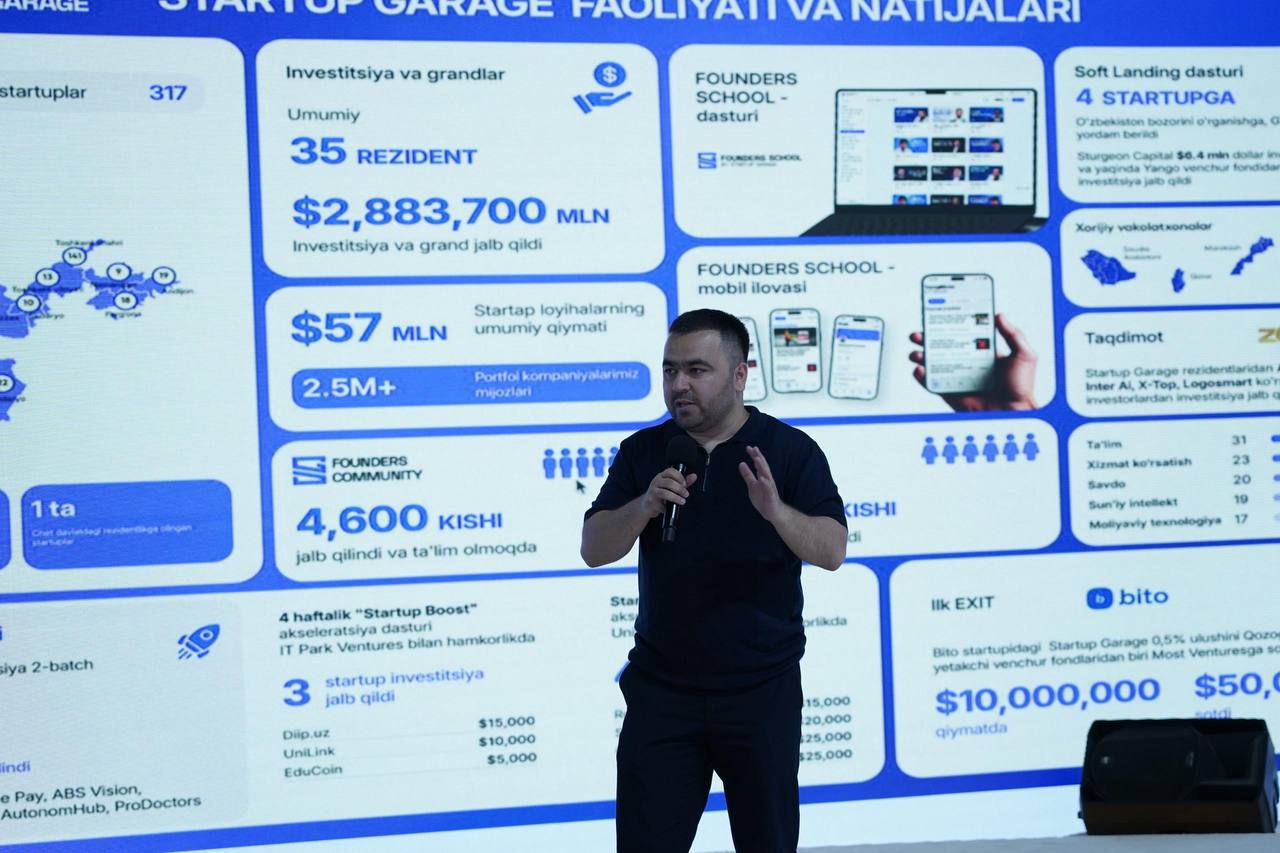
According to the organization’s own figures, the Startup Garage ecosystem has now worked with or built around its portfolio approximately 500 startups. This makes it one of the largest startup pipelines to emerge in Central Asia.
Several companies associated with the ecosystem — Bito, AliPos, Darstop, Joymee, Bigmart, and Nikoh App — have already reached valuations in the multi-million-dollar range. According to information circulating around the organization, some startups have reached valuations of approximately $5 million to $15 million.
Not all of these figures have been independently verified. But they point to something increasingly important to investors: the ability to systematize venture creation at scale.
Startup Garage is gradually beginning to look less like an accelerator and more like infrastructure designed to repeatedly create new companies. And that distinction matters.
Investors may be looking not at the startups, but at the machine that creates them
A traditional VC fund raises capital and searches for strong founders. A startup studio takes a different approach. It builds a system that continuously identifies new opportunities, validates them, recruits founders, launches companies, and takes them toward capital.
If that system works, the most valuable asset may no longer be an individual startup. The most valuable asset could be the machine itself — the system that repeatedly creates companies. That appears to be the thesis emerging around Startup Garage.
Today, its network extends across Uzbekistan, while its programs have created a high-velocity pipeline of founders, startups, and companies ready for investment within a young venture market. In practical terms, an investor backing Startup Garage may gain exposure to more than a single startup. They may gain access to an entire venture-creation infrastructure.
The next rocket internet — from Central Asia?
The comparison should not be taken literally. But internationally, Rocket Internet, Idealab, Atomic, and other venture builders have demonstrated that venture creation itself can become a highly valuable business model.
In emerging markets, the opportunity may be even more interesting. Thousands of technology business models have already been proven around the world. In many cases, the task is not to invent an entirely new category, but to identify a model that already works, localize it, find the right founder, and execute faster than everyone else. Artificial intelligence is strengthening this model further. Research work that previously required teams of several people can increasingly be automated.
MVPs can be built within weeks. Market analysis, design, development, testing, sales, and much of the operational workload can increasingly be handled by small teams with the help of AI. This could fundamentally change the economics of startup studios over the coming decade. Startup Garage appears to be positioning itself at the center of this shift.
Muhammad Khalil is building something larger than a traditional VC model
The ambition surrounding Muhammad Khalil has also gradually moved beyond simply running another accelerator or investment platform. The core thesis is straightforward: Build infrastructure capable of systematically producing startups.
Education creates new entrepreneurs. Entrepreneurs generate new ideas. The strongest ideas move into validation. Validated ideas enter the venture-building stage. The strongest companies receive distribution and capital.
Successful founders then bring their experience and capital back into the ecosystem. This is not simply an accelerator. It is a startup flywheel. For Uzbekistan, its potential impact could extend well beyond Startup Garage itself. In recent years, the country has made significant investments in technological infrastructure, IT exports, entrepreneurship, and startup development.
But across much of Central Asia, an important link is still missing: private infrastructure capable of turning talent into hundreds, and eventually thousands, of technology companies capable of attracting investment. Startup Garage is attempting to occupy precisely that layer.
Why is an exit particularly interesting right now?
Timing changes everything. Uzbekistan is increasingly attracting the attention of international technology companies and investors. ICTWEEK is temporarily turning Tashkent into a gathering point for the region’s technology ecosystem.
A strategic investor entering Startup Garage today would simultaneously be investing in three things:
- Uzbekistan.
- The venture-creation model in Central Asia.
- The next generation of AI-powered startup studios.
That combination is relatively rare. It may also explain why the discussions appear to be centered not on individual startups, but on the platform itself. In other words, the most valuable company created by Startup Garage in the future may not be one of the startups in its portfolio. It could be Startup Garage itself.
What could the deal look like?
Several scenarios are possible. A global venture platform or investment group could acquire a strategic minority stake. A large institutional investor could purchase a significant stake in the company and finance its regional expansion. A technology holding company could acquire the venture-building operation while retaining Muhammad Khalil and the existing management team. Or Startup Garage could pursue a large institutional capital raise instead of a traditional exit.
At this stage, each of these possibilities remains speculative. Startup Garage has made no official statement regarding a company sale process or a signed transaction. Nevertheless, with Uzbekistan’s technology ecosystem gathering in Tashkent this week, it is becoming increasingly difficult to dismiss the conversations surrounding the company as mere rumors.
If an investment or acquisition deal does materialize, it could represent an important signal for the region. Central Asia has already begun producing startups capable of attracting international capital. The next stage could be different:
Can Central Asia build an institution whose product is the creation of startups themselves?
Startup Garage is attempting to prove that it can. And investors may want to own a piece of that machine before it becomes even larger.
Editor’s note: Information regarding potential investment or transaction discussions has not been officially confirmed by Startup Garage. No definitive transaction has been publicly announced. Portfolio size, valuations and other company-specific operating figures referenced in this article are based on information attributed to or circulated around the organization and should not be interpreted as independently audited financial data.








