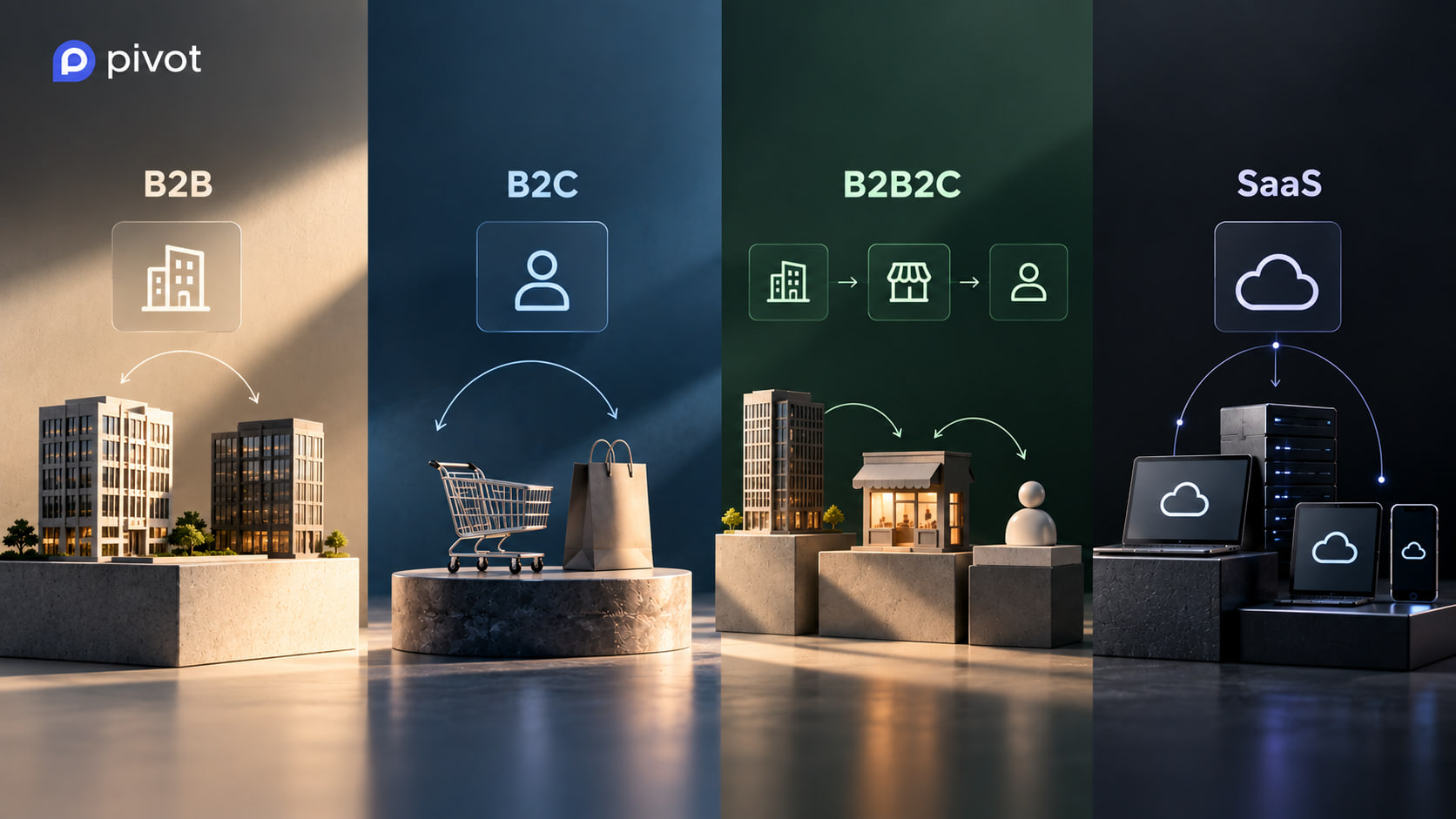
At least half of a startup’s potential success relies on its chosen business model—the structural methodology of converting created value into revenue (monetization). Selling identical software to enterprise clients (B2B) versus individual consumers (B2C) demands completely different go-to-market approaches, budgets, and marketing strategies.
To learn how to calculate unit economics and LTV/CAC ratios specifically for SaaS and B2B models, read our dedicated article: Calculating unit economics, LTV, and CAC
1. Key features and differences of core business models
| Business model | Target customer base | Sales cycle | Key tracking metrics | Notable examples |
| B2B (Business-to-Business) | Enterprises & SME organizations | Prolonged (1–6 months), complex negotiations | ACV (Annual Contract Value), Churn rate | Slack, Salesforce, Modme |
| B2C (Business-to-Consumer) | Mass-market individual consumers | Short, highly impulsive or emotional purchases | CAC, LTV, ARPU, Viral K-factor | Netflix, Spotify, Uzum Market |
| B2B2C | Reaching the end consumer (B2C) via business partners (B2B) | Moderately complex, heavily reliance on partnerships | GMV, Take rate, Active users | Food delivery platforms, Payme, Click |
| SaaS (Software-as-a-Service) | Subscription-paying B2B or B2C users | Highly automated, recurring monthly/annual billing | ARR, MRR, Net Retention, CAC Payback | Zoom, Canva, Figma |
According to venture market research by Gainsight and OpenView, the fastest-growing SaaS startups entering their Series A stage aim to scale their Annual Recurring Revenue (ARR) by at least 2x to 3x annually. This aggressive scaling trajectory is widely known in the industry as the T2D3 framework (Triple, Triple, Double, Double, Double).
Selecting the appropriate business model in the early stages optimizes Customer Acquisition Costs (CAC) and significantly accelerates revenue generation by shortening your sales pipeline.