

Kazakhstan’s startup ecosystem has expanded rapidly in recent years. According to the 2026 Kazakhstan Startup Landscape report, the RISE database includes more than 1,500 startups and technology companies in Kazakhstan, over 203 venture-backed companies, and its first unicorn. Venture capital funding grew from $20 million in 2020 to $209 million in 2025. For 2026, RISE Research forecasts the figure to exceed $460 million.
At first glance, these figures suggest that the ecosystem is overcoming its main challenge — the lack of startups and capital. But the report’s most important conclusion lies elsewhere. As a startup grows, its challenges change as well. At the earliest stage, the main question is straightforward: “How do we raise money?”
Funding shortages are identified as the main growth barrier by 37% of idea-stage companies and 40% of MVP-stage companies. But once a company finds its first users, the problem changes. At the first-users stage, customer acquisition and sales become the biggest challenge, cited by 42% of companies.
Once a company begins generating regular revenue, the figure rises further: 47% of companies at the regular-revenue stage and 43% of companies at the active-growth stage identify customer acquisition and sales as their main bottleneck. The progression can be summarized as follows:
Idea → capital
MVP → capital
First users → customers
Revenue → sales
Growth → scaling
Capital is essential for a startup, but capital alone does not create growth. It gives a company the resources to find customers. Once a startup reaches a certain stage, the more important question is no longer “How much funding did it raise?” but rather “How much real demand did it create with that funding?”
According to the report, 47% of early-stage companies and 48% of scaling companies identify international expansion as a priority for the next 12 months. However, there is a significant gap between the intention to enter international markets and actual results.
Only 16% of early-stage companies have paying customers abroad. Among scaling companies, the figure rises to 40%. In other words, scaling companies are 2.5 times more likely than early-stage companies to have paying customers in international markets.
This suggests that the main challenge for Kazakhstani startups is not a lack of ambition to operate globally. The bigger issue is execution, sales channels, and access to the right markets.
For 34% of early-stage companies, insufficient budget for international expansion is the main obstacle. Among scaling companies, however, financial constraints are no longer the dominant problem. Instead, 33% of companies say they lack a sales team or partners abroad.
In addition, 15% of scaling companies identify issues related to local presence in foreign markets, legal requirements, regulation, and payment systems as barriers.
The challenge therefore changes as the company grows:
Early stage: “We do not have enough money to expand abroad.”
Scaling stage: “We have entered the market, but we do not have people or partners there to sell our product.”
Legal, regulatory, payment, and local-presence issues add another layer to the challenge. For 15% of scaling companies, these factors are among the main barriers to international expansion.
For founders, networks matter as much as capital
The report also highlights another side of the problem through interviews with founders. Of the 30 founders interviewed, 15 identified attracting investors as a major challenge. Eight pointed to a lack of local capital, while seven said that capital for Series A and growth-stage companies remains limited in Kazakhstan.
Another six founders noted that foreign investors expect companies to relocate or establish a presence in another country. When it comes to international expansion, different challenges come to the forefront:
- 12 founders cited cultural and language differences;
- 8 founders pointed to a lack of networks and reputation in target markets;
- 4 founders identified regulatory issues;
- 2 founders mentioned visa and immigration restrictions.
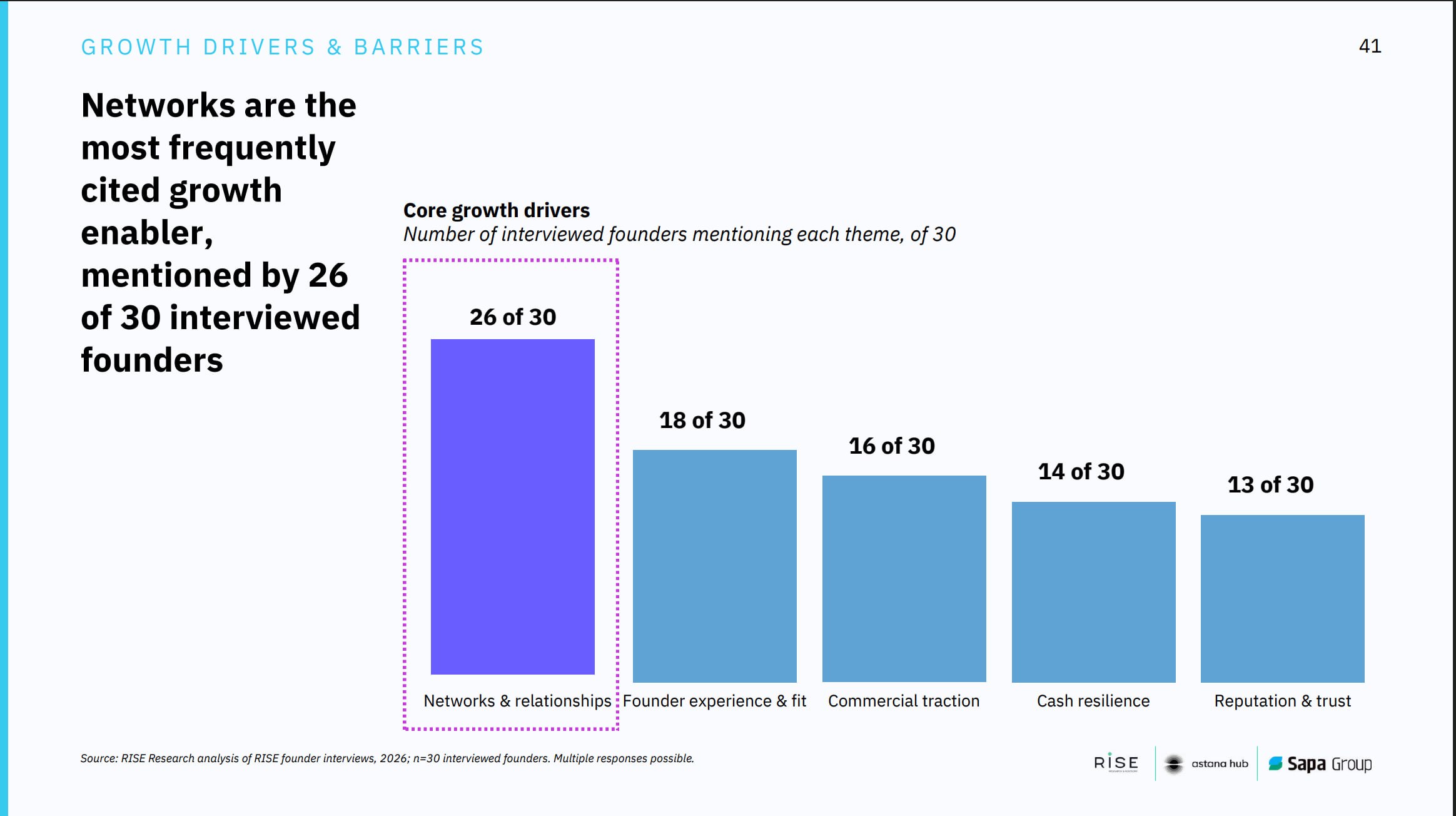
At the same time, 26 of the 30 founders considered networks and relationships important for company growth. This means that as a company becomes larger, its needs extend beyond financial resources. Investors, customers, partners, local experts, and international connections also become part of the infrastructure required for growth.
Venture funding increased from $20 million in 2020 to $209 million in 2025. For 2026, the forecast exceeds $460 million. This represents roughly 23-fold growth. However, this figure should not automatically be interpreted as proof that a deep venture market has already emerged in Kazakhstan.
The report itself notes that the growth in capital remains concentrated. The year 2025 became a turning point for Kazakhstan’s startup ecosystem: Higgsfield became the country’s first unicorn, and its large funding rounds made a significant contribution to the sharp increase in total venture funding.
This is why the two indicators need to be viewed separately: Is large-scale venture capital emerging in Kazakhstan? — Yes.
Does this mean a deep venture market has already developed that can consistently provide capital for many companies as they move into later stages? — It is still too early to give a definitive answer.tently provide capital for many companies as they move into later stages? — It is still too early to give a definitive answer.

Higgsfield is particularly important for Kazakhstan’s ecosystem. According to the report, the company was founded in 2023, has reached the Series B stage, raised a total of $538 million, and has more than 30 million global users.
This demonstrates that it is possible to build a global company from Kazakhstan. The next challenge for the ecosystem is whether such results can be replicated.
If several more Kazakhstani companies achieve similar global results in the coming years, Higgsfield could eventually be viewed not as an isolated success, but as part of a mature startup pipeline.
Kazakhstan’s startup ecosystem is moving from a stage focused on increasing the number of startups and attracting capital toward a stage focused on global growth. The key challenge is no longer simply raising investment. It is about acquiring customers, entering international markets, and scaling companies.
Higgsfield has demonstrated that companies capable of competing globally can emerge from Kazakhstan. The next task for the ecosystem is to move beyond producing a single successful unicorn and build an environment capable of consistently creating global companies.
This article is based on the RISE Research — Kazakhstan Startup Landscape 2026 report. The report was prepared using a survey of 602 companies, interviews with 30 founders, Astana Hub data, and a venture deal database.










