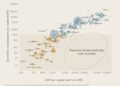
Economic transformations are rare, but history shows they are possible. One of the most famous examples is South Korea’s “Miracle on the Han River”—the country’s rapid rise from poverty in the 1960s to becoming a global economic powerhouse by the 1990s.
As World Bank economist Indermit Gill observed, “Korea went from being one of the poorest countries in the world to one of the richest within a single generation” (World Bank, 2020). This transformation was not luck—it was the result of clear vision, hard choices, and national discipline.
Today, Uzbekistan faces a similar turning point. With a young population, rich natural resources, and a strategic location in Central Asia, the country has the chance to follow its own path to prosperity. By studying Korea’s lessons, Uzbekistan can design a future that is both ambitious and achievable.
How South Korea Transformed Itself
When the Korean War ended in 1953, South Korea’s GDP per capita was around $80—comparable to the poorest nations in Africa. By 1990, it had surpassed $6,000, and today it exceeds $30,000 (IMF, 2023).
This was made possible by a few key strategies:
- A Clear National Vision
President Park Chung-hee declared in the 1960s that Korea would “escape poverty through industrialization.” The government created five-year development plans and mobilized the bureaucracy to achieve them. - Export-Led Growth
Instead of focusing only on its domestic market, Korea forced its companies to compete abroad. As economist Alice Amsden explained, “Export performance was the yardstick by which firms were judged.” This created a culture of quality and efficiency. - Education First
By the 1970s, Korea had achieved near-universal literacy. Heavy investments in schools, universities, and vocational institutes created a generation of engineers, technicians, and entrepreneurs. - Public–Private Partnership
The state worked closely with big family-run companies, known as chaebols (Samsung, Hyundai, LG). In return for state support, these firms had to meet export targets and upgrade technology. - Discipline and Sacrifice
Koreans worked long hours, saved money, and prioritized the future over the present. As one Korean proverb during that era said: “Tighten your belts today so your children can loosen theirs tomorrow.”
Uzbekistan’s Current Position
Uzbekistan is not emerging from war like Korea in the 1950s, but it faces its own challenges:
- Over-reliance on commodities like gas, cotton, and gold.
- High youth unemployment.
- Limited industrial diversification.
- A financial system still developing.
At the same time, Uzbekistan has strong advantages:
- A population of over 36 million, with more than 60% under 30.
- Strategic location at the heart of Eurasia, connecting China, Russia, and the Middle East.
- Reform momentum since 2016, opening markets and attracting investors.
Like Korea in the 1960s, Uzbekistan stands at a moment of decision: remain a resource exporter or become an industrial, knowledge-driven economy.
What Uzbekistan can learn
- Set a Bold National Goal
Just as Korea aimed to “industrialize or perish,” Uzbekistan should aim for a $700B – $1 trillion economy by 2050. This vision must be repeated at every level of government and society. - Compete Globally, Not Just Locally
Instead of exporting raw cotton, gas, or minerals, Uzbekistan should focus on higher-value exports: branded textiles, green energy, agri-tech, IT services, and automotive components. - Invest in People Above All
Korea produced engineers and scientists; Uzbekistan must do the same with software developers, data analysts, and skilled technicians. As President Shavkat Mirziyoyev stated in 2020, “The future of Uzbekistan will be decided not by natural resources, but by the knowledge and skills of our youth.” - Build Strong State–Business Alliances
Uzbekistan can nurture “national champions” in solar energy, agri-processing, micro SaaS, and logistics. Government should provide credit and infrastructure, but firms must be held accountable for performance. - Promote Long-Term Thinking
Transformation will not come overnight. Korea succeeded because it maintained policies for decades. Uzbekistan must fight corruption, reward merit, and stay committed to long-term industrial policy. - Invest in Infrastructure and Trade Corridors
Uzbekistan can revive the Silk Road legacy by becoming the logistics hub of Central Eurasia—building high-speed rail, highways, renewable power grids, and digital infrastructure. - Leverage Culture and Soft Power
Korea built global soft power through K-pop, cinema, and cuisine. Uzbekistan, with its rich heritage, art, and tourism potential, can do the same by promoting Uzbek culture as a global brand.
Toward a “Miracle on the Amu Darya”
Korea’s experience shows that miracles are built, not granted. With vision, discipline, and investment in people, Uzbekistan can create its own “Miracle on the Amu Darya.”
By 2050, Tashkent could stand as a modern hub of Central Asia—an engine of startups, clean energy, smart agriculture, and cultural exports. The Han River became a symbol of Korea’s rise; the Amu Darya and Syr Darya can become symbols of Uzbekistan’s own transformation.
As World Bank President David Malpass said in 2021: “The miracle of Korea tells us that fast development is possible. The question is not whether it can be done, but whether leaders choose to do it.”
Uzbekistan now has the chance to make that choice.
Sources & Resources:
- World Bank (2020). Korea’s Development Experience.
- Alice Amsden (1989). Asia’s Next Giant: South Korea and Late Industrialization.
- IMF (2023). World Economic Outlook Data.
- Shavkat Mirziyoyev (2020). Address to the Oliy Majlis.
- Malpass, D. (2021). Remarks on Korea’s Economic Miracle.
Pivot.uz