

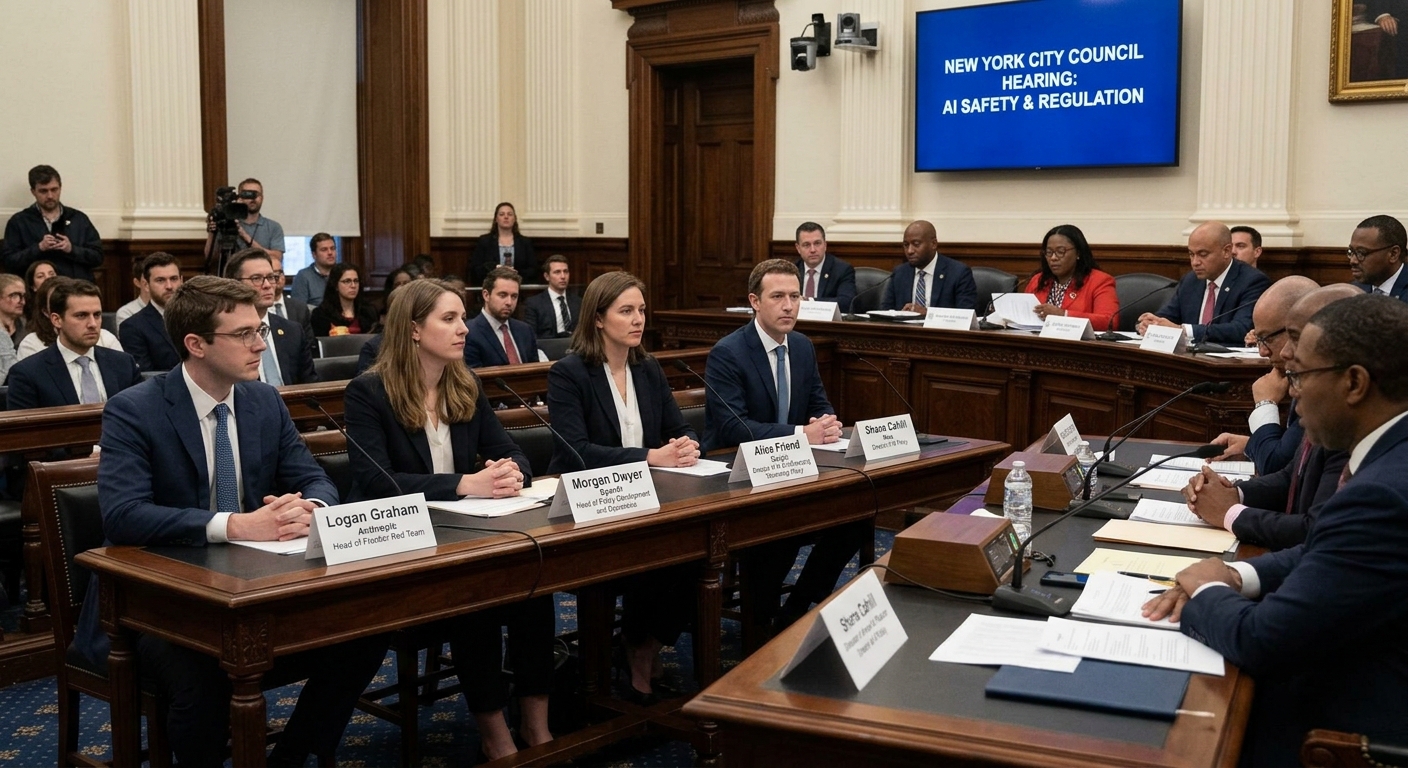
On October 5, the New York City Council held a hearing focused on artificial intelligence safety. All 51 members of the City Council participated. Representatives of OpenAI, Anthropic, Google, and Meta answered questions about the risks associated with AI technologies and the safety measures taken by their companies.
The hearing became one of the first major sworn public appearances by AI companies on the issue of AI safety. The companies had initially declined the Council’s invitation but agreed to participate after facing the threat of subpoenas. Meta, meanwhile, had agreed to send a representative from the beginning.
The companies’ CEOs did not attend the hearing. Instead, they were represented by senior officials. Anthropic was represented by Logan Graham, head of Frontier Red Team; OpenAI by Morgan Dwyer, head of policy development and operations; Google by Alice Friend, director of AI and emerging technology policy; and Meta by Shane Cahill, director of AI policy.
The Council’s main focus was not only on AI models themselves, but also on the potential harm they could cause and the responsibility of companies in such cases.
One of the proposals being considered by the Council would require independent third-party testing of AI systems before they are released to the market. Under the proposal, an AI model would have to undergo testing of its safety, data privacy, bias, and other aspects before being sold or used in New York City. The system would also be required to have a human-operated shutdown mechanism, or a “kill switch.” Companies that violate these requirements could face fines of up to $25,000.
Another proposal would allow individuals harmed by AI companies to seek compensation through the courts. This would apply where the harm was reasonably foreseeable and the company had failed to take adequate measures to prevent it.
The Council also plans to strengthen oversight of AI-related safety incidents. For example, companies working with the city could be required to report AI-related safety incidents within 24 hours, with such cases potentially made public. Another proposal would require companies to establish specific response plans for AI-related emergencies.
Another focus of the hearing was the protection of AI company whistleblowers — employees who report dangerous or unlawful practices within their companies. Under one of the proposals, individuals who report AI-related violations could receive a portion of the fines or other funds collected as a result.
These initiatives are not yet law. They are currently being discussed, and their final form could change. Official New York City Council documents list most of these proposals as still being in the “preconsidered” stage.
The developments in New York reflect a broader debate in the United States over how AI companies should be regulated. For now, companies largely rely on their own internal safety systems. The City Council, however, is considering making some of these requirements mandatory through legislation.
If adopted, the proposals would require AI companies operating in New York City not only to develop models, but also to conduct independent safety testing, provide mechanisms for emergency shutdowns, disclose safety incidents, and assume responsibility for certain harms caused to users.
For this reason, the October 5 hearing can be viewed not simply as another discussion about AI, but as part of a legislative process that could shape how AI companies are regulated in the future.








