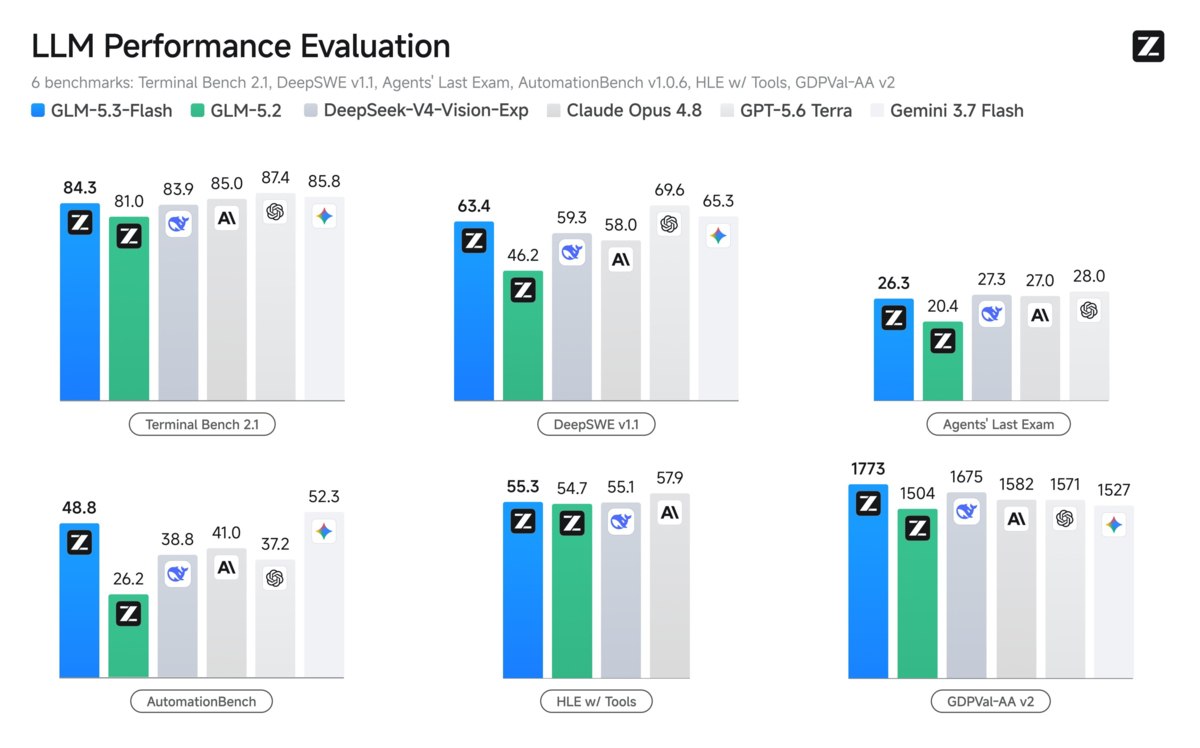
Chinese AI company Z.ai has officially introduced GLM-5.3-Flash, a new model in the GLM family. The company describes it as the first native multimodal model in the GLM-5 series. The model is based on a Mixture-of-Experts (MoE) architecture with 320 billion total parameters, of which approximately 18 billion are active for each query. This approach is designed to handle complex tasks while reducing the computing resources required for inference.
GLM-5.3-Flash can process multimodal data, including text and images. It supports a 1 million-token context window and is designed for programming, agentic tasks, document processing, and visual analysis.
According to Z.ai, the model uses a hybrid architecture combining sparse attention and linear attention. The company says this approach helps reduce computational costs when working with long-context inputs.
Before its official release, GLM-5.3-Flash appeared on OpenRouter and OpenCode under the anonymous codename Ox Alpha. The model became available for testing on August 20 and quickly attracted attention among developers. On August 26, Z.ai officially confirmed that Ox Alpha was a pre-release version of GLM-5.3-Flash. The company said the anonymous release was used to gather unbiased feedback from users before the official launch.
The weights of GLM-5.3-Flash have been released on Hugging Face under the MIT license, allowing developers to download, deploy, and customize the model on their own infrastructure.
The model is also available across Z.ai’s ecosystem, including its ZCode environment. On OpenRouter, GLM-5.3-Flash is positioned for multimodal processing, coding, and long-running agentic tasks.
Z.ai also reports significant improvements in the model’s cost-efficiency and performance compared with the previous GLM-5.2. However, these performance claims are based on the company’s own benchmarks and testing methodology and should therefore be considered accordingly.